Explore the key components of experiential learning that foster true engagement and how many educational practices fall short in delivering meaningful experiences.
**Situating Experiential Learning: Understanding What Truly Matters**
When it comes to learning, not every experience translates into genuinely impactful knowledge. So, what distinguishes meaningful learning moments from those that fall flat? It largely boils down to personal significance, authenticity, and context.
Chris Unger, who has been teaching a course titled “The Power of Experiential Learning” to seasoned educators for several years, consistently uncovers a prevailing misconception: many educators walk in believing they understand experiential learning, only to leave with a renewed sense of its depth and complexity. During the initial weeks of his course, there are no assigned readings; instead, he encourages participants to reflect on their personal experiences, noting three transformative learning moments and three that felt pointless. This exercise sparks an intriguing dialogue about the qualities that made the difference.
What tends to emerge from these reflective discussions are several key components of valuable learning experiences. Educators highlight the importance of being immersed in personally relevant topics, the chance to experiment within authentic activities, receiving constructive feedback from knowledgeable figures, and engaging in supportive relationships with mentors or peers—elements that are repeatedly linked to enhanced engagement and educational success.
But here lies the paradox: despite the value inherent in these characteristics, participants frequently tag traditional educational experiences and professional development as lacking impact. A 2024 Gallup survey revealed that less than 20% of young learners feel that what they’re taught in school resonates as important or interesting. This stark reality raises critical questions: If educational settings are supposed to foster meaningful learning, why do many label them ineffective?
The discomforting reality is that if our schools and professional development programs generate more unhelpful experiences than good ones, we must reevaluate what constitutes effective learning. It begs the inquiry: What sorts of experiences genuinely lead to transformative learning?
**The Core of Experiential Learning: Kolb’s Cycle**
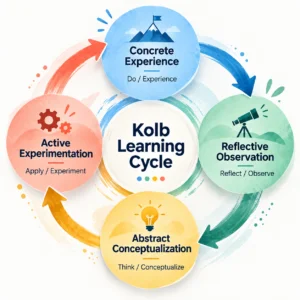
When educators reference experiential learning, they often turn to David Kolb, whose learning cycle emphasizes the necessity of reflection and experience. Kolb posits that meaningful learning is a process—not a simple transaction of information. It’s about engaging with experience, reflecting on it, conceptualizing what it means, and applying it in future scenarios.
Kolb’s model underscores the cyclic nature of learning but falls short of specifying which particular experiences foster significant learning outcomes. It’s a pivotal oversight, considering that not all experiences yield valuable insights. Kolb insists that learners are most successful when transforming experiences through active engagement, iterative reflection, and practical action—not simply amassing experiences passively.
Thus, unpacking the nuances of learning experiences is imperative. The real questions are: What types of engagement catalyze deeper understanding? What reflections lead to real changes in thinking or behavior in a given domain?
All of this points to a necessary shift in how we approach educational design. If we ignore the elements of genuine interest and the kinds of experiences learners engage in, we risk perpetuating disengagement and apathy. Schools often stick to rigid curricula focused on prescribed topics rather than tapping into students’ intrinsic passions.
As discussions around experiential learning gain traction, the dialogue needs to shift from merely doing activities to considering the holistic learning experience—meaningful, authentic engagements that inspire students to not only learn but to apply their knowledge in practical, real-world contexts.
Ultimately, addressing these questions will pave the way for a more nuanced understanding of how to create pathways for effective experiential learning.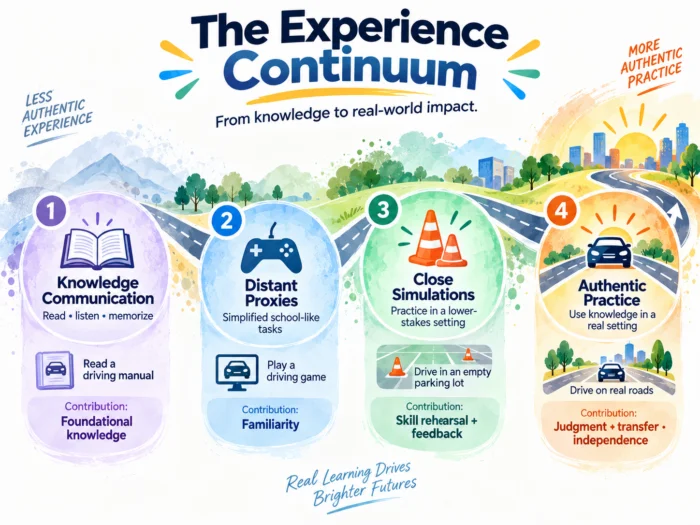 Investing time in diverse learning experiences—going beyond basic knowledge to authentic practice—requires deliberate planning. This doesn't mean every lesson must morph into a full internship. Instead, we should normalize the integration of experiences that promote genuine engagement. In education, not all experiences are created equal; as John Dewey articulated long ago, experience alone does not guarantee learning. If we want students to develop capabilities like critical thinking and creativity, we cannot settle for the superficial experiences that often characterize the current educational structure.
In essence, the goal isn’t just to create assignments that mimic real tasks, but to integrate genuine purpose behind every learning experience. Authentic projects—those that prompt students to address real-world issues, make decisions, and receive feedback—will yield far superior outcomes than rote assignments driven solely by the desire for a good grade. By facilitating such experiences, schools can foster an environment where students engage in authentic work that prepares them for the complexities of life beyond the classroom.
Redefining Authentic Learning Environments
Schools, as they're typically structured, fall short of fostering deep, authentic engagement with students. A thorough investigation, spanning six years and involving thirty of the nation’s most forward-thinking high schools, revealed that meaningful learning rarely becomes the norm. Instead, it is often sidelined by rigid curricula and traditional schedule constraints. If you’re looking to revamp education, you must confront this disheartening reality: forty-five-minute periods that push students from one classroom to another simply don't allow the kind of immersive learning experiences that prepare them for real life. To genuinely engage students, we need a system overhaul that prioritizes extended periods for in-depth projects, opportunities for apprenticeships, and a support structure that encourages real-world engagement. The current design of learning environments focuses heavily on content coverage, sidelining the more vital aspect of cultivating experiences based on student interests. The crux of education should be about creating authentic, meaningful opportunities for students, rather than a relentless march through a predefined curriculum.The Disconnect Between Knowledge and Application
Here’s a stark analogy: a young person can cram the contents of a driver’s manual, passing a test effortlessly. That knowledge is foundational, but it doesn't guarantee that this individual will successfully navigate the complexities of real driving. Mastering the road requires practical experience—this means hitting the gas and brakes, taking turns, and learning to gauge traffic dynamics, often with an apprehensive adult in the passenger seat praying they’ll make good decisions. The majority of our educational systems still dwell on the theoretical, expecting that mere exposure to information equates to actual proficiency in applying it. Unfortunately, that assumption is flawed. Research shows that knowledge transfer—applying what you’ve learned in different contexts—is no straightforward feat. Students often struggle to see the connections between classroom concepts and real-world scenarios. This disconnect emphasizes that knowledge transmission, while necessary, isn’t enough. Genuine skills in communication, problem-solving, and judgment must be developed through hands-on practice and contextual learning.Mapping the Experience Continuum
One fruitful approach to tackle these issues is to view learning as a continuum, ranging from simple information absorption to engaging in substantial, real-world tasks with meaningful outcomes. The concept, championed by organizations like Getting Smart, outlines a taxonomy of experiences that help educators funnel efforts towards authentic learning.
Investing time in diverse learning experiences—going beyond basic knowledge to authentic practice—requires deliberate planning. This doesn't mean every lesson must morph into a full internship. Instead, we should normalize the integration of experiences that promote genuine engagement. In education, not all experiences are created equal; as John Dewey articulated long ago, experience alone does not guarantee learning. If we want students to develop capabilities like critical thinking and creativity, we cannot settle for the superficial experiences that often characterize the current educational structure.
In essence, the goal isn’t just to create assignments that mimic real tasks, but to integrate genuine purpose behind every learning experience. Authentic projects—those that prompt students to address real-world issues, make decisions, and receive feedback—will yield far superior outcomes than rote assignments driven solely by the desire for a good grade. By facilitating such experiences, schools can foster an environment where students engage in authentic work that prepares them for the complexities of life beyond the classroom.
Discussion
Sign in to join the discussion.