Global reading scores have sharply declined, with significant implications for educational systems and students' future performance.
By Andreas Schleicher, OECD Director for Education and Skills
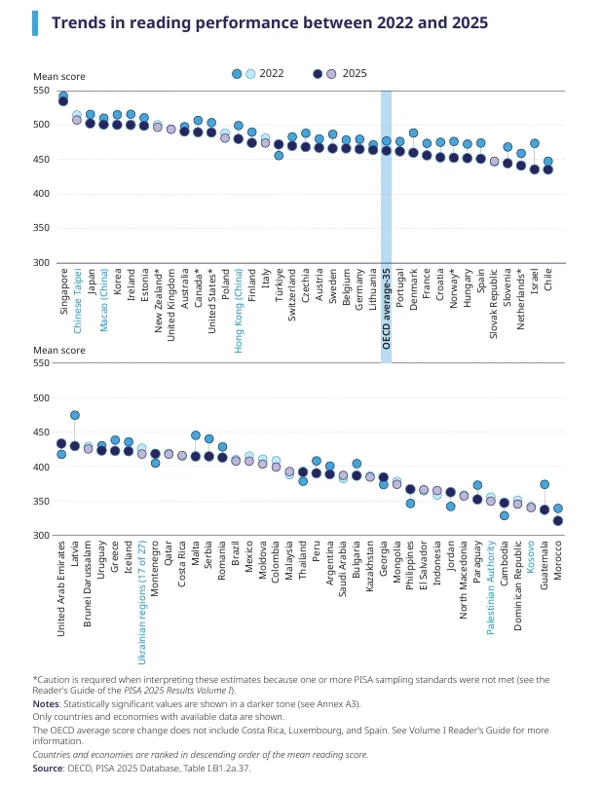
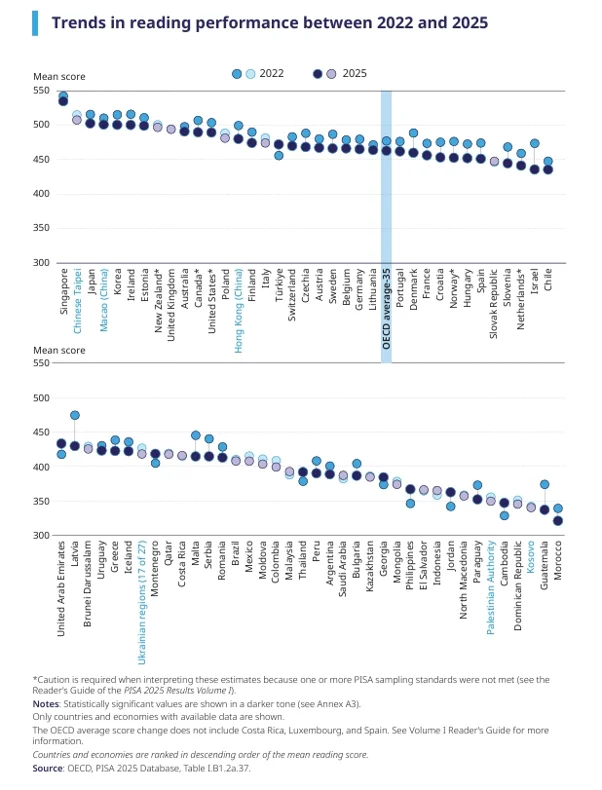
The latest results from the Programme for International Student Assessment (PISA) reveal alarming trends in global reading scores, with a notable decline observed in three-quarters of participating education systems between 2018 and 2025. Out of 74 systems with comparable data, 56 reported significant drops, leading to an average decrease of 25 score points across the OECD. In some countries like Iceland and Slovenia, the decline exceeded 50 points. With 20 score points roughly equating to a year's worth of learning, the findings indicate that many 15-year-olds in 2025 were performing at levels expected of 14-year-olds.
A handful of countries stood out by achieving statistically significant improvements: Qatar (up 11 points), Brunei Darussalam (18), Cambodia (26), the Philippines (27), and Zambia (50). While these nations still fall below the OECD average, their gains deserve acknowledgment amidst the broader global downturn.
Analyzing Performance Declines
The widespread fall in reading scores calls for a deeper examination, particularly because reading proficiency is critical for success across other subjects. PISA data highlights that performance gaps based on gender and immigration status have remained stable. However, a significant number of students struggled with reading tasks that required higher-order thinking, particularly those involving longer texts. These tasks necessitate concentrated reading and the ability to synthesize information for coherent understanding.
Contrastingly, students increasingly exhibit a tendency to read in haste, impacting their comprehension. The portion of students who read quickly but inaccurately nearly doubled to 9% between 2018 and 2025, with notable increases in Kosovo, the Dominican Republic, and Bulgaria, where the rise exceeded 10 percentage points. Students in these systems report experiencing digital distractions that surpass the OECD average.
The Role of Digital Distractions and COVID-19
There's a suggestion that the rise of hasty reading habits correlates with increased digital engagement. The time students spend daily on social networks has grown by nearly six percentage points since 2022. While the pandemic and ensuing school closures may have contributed to some of these declining scores, structural issues in education existed prior to COVID-19. A comparison of 15-year-olds' PISA results with the earlier PIRLS (Progress in International Reading Literacy Study) data of 9- to 10-year-olds shows that declines in reading skills might have roots in earlier educational experiences and learners' home environments.
This earlier research casts a shadow on the reading skills of younger students, indicating that the worrying trends aren't limited to teenagers alone; they extend back to primary school levels.
Additional Insights from PISA Data
The PISA analysis highlights other concerning trends: Students expressed less effort during the 2025 assessments compared to 2022 and 2018. Engagement levels appear to have dropped, particularly in countries where reading scores witnessed the steepest declines. Furthermore, there’s been a noticeable decrease in students’ curiosity about diverse subjects, and those who regard school as a “waste of time” correlate with larger drops in performance.
Perhaps surprisingly, students from the most advantaged socio-economic backgrounds experienced the most significant declines in reading performance from 2018 to 2025. This trend contradicts typical expectations, suggesting that well-off students are underperforming relative to their backgrounds. Consequently, the socio-economic gap between the advantaged and disadvantaged has narrowed by an average of 11 points across 35 OECD countries.
Implications for Education Systems
The persistent downward trend in reading scores largely reflects a decline in student focus and attention. This raises critical questions for educators and policymakers today, especially in an age increasingly influenced by artificial intelligence. Skills like critical reading and evaluating credible information will become vital as technology evolves. Therefore, the pressing task for education systems is to rekindle young people's interest in reading. This is not just a challenge confined to students; it parallels a broader trend where many adults have also drifted away from reading for pleasure.
This article is based on a chapter from the PISA 2025 Insights and Interpretations brochure.
Discussion
Sign in to join the discussion.