Discover how a shared framework can enhance collaboration and coherence in school transformation, accelerating learning outcomes across diverse educational models.
The domain of school transformation is filled with various design frameworks, each tailored to specific objectives. Over the years, school systems and partner organizations have dedicated resources to develop approaches that aim to reshape educational experiences effectively. Yet, a challenge often arises: partners tend to describe similar concepts using distinct terminologies, resulting in what feels like translation work rather than collaboration.
At the core of this complexity lies a pressing question: Is there a common foundation beneath these diverse frameworks? Research indicates that there is indeed a shared architectural structure, derived from analyzing numerous education reform models.
Identifying the Core Structure
Our exploration stems from the premise established by Sangeet Paul Choudary in his book, Reshuffle, which posits that if school transformation frameworks possess universal components, then establishing a unified terminology may expedite progress across the sector. This endeavor doesn’t seek to replace or undermine existing frameworks; instead, it aims to foster a common vocabulary that enhances collective advancement.
The work we've conducted with various networked districts across the U.S. supports this hypothesis. Although different frameworks may be in use, they often map to the same central questions about educational purpose and design.
The Learning Innovation Wayfinder
We've conceptualized a model called the Learning Innovation Wayfinder, which organizes the school transformation process around seven fundamental elements. Each of these components is articulated through guiding questions, creating a systematic approach to navigate educational reform:
| Element | Guiding Question | Coverage |
| WHY Community Vision |
Why are we making this change? | Community Need, Mission, Vision, Values & Norms |
| WHAT Learner Outcomes |
What should our learners know and be able to do? | Learner Portrait, Standards, Competencies, Learning Progressions, Educator & Leader Portraits |
| HOW Learning Model |
How is the learning experience designed to support reaching the Learner Outcomes? | Climate & Culture, Design Principles, Learning Experience, Instruction & Facilitation, Assessment, Professional Learning |
| FOR WHOM Signals |
For whom is student proficiency and learning translated? | Reports, Portfolios, Transcripts, Credentials |
| WHERE Learning Ecosystem |
Where will learning occur and what operational structures will support learning? | Technology, Facilities, Staffing & Scheduling, Transportation, Partnerships, Networks |
| WHEN Strategy |
When will this work happen? | Strategic Direction, Leading Change, Finance, Implementation, Measuring Success, Research & Development |
| WHAT NEXT Impact & Scaling |
What’s next to accelerate impact on more learners? | Codifying, Sharing, Landscape Analysis, Theory of Change, Scaling |
While communities may not address these questions in a linear fashion, they typically return to them throughout their transformative efforts. The Wayfinder is less about following a strict sequence and more about fostering interconnected discussions that ultimately benefit student outcomes.
Insights from Framework Analysis
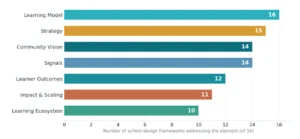
In our analysis, we examined 16 leading school-design frameworks and compared them against seven prominent change and improvement models. This comparative evaluation reveals that each framework incorporates elements that align with the overarching principles of transformation.
Our findings highlight a few crucial observations:
- The Learning Model is Consistent: All frameworks (16 out of 16) address how students achieve proficiency.
- Focus on Vision and Strategy: Fourteen frameworks center on community vision, while 15 address strategy, underscoring the importance placed on guiding principles and implementation practices.
- Learning Ecosystem Coverage is Variable: Only 10 frameworks explicitly detail where learning occurs, indicating a gap in infrastructural representation.
- Integration of Process and Content: Our investigation revealed connections between frameworks and models through the lenses of Community Vision, Strategy, and Impact & Scaling.
The Importance of Shared Architecture
The intention behind establishing a shared architectural framework is not to diminish the value of existing frameworks used by various organizations. Instead, it offers a navigational tool that allows different models to coexist and collaborate. It doesn't require communities to abandon their established methods; rather, it clarifies how distinct routes can lead to common educational goals and identifies opportunities for deeper cooperation.
Here are three pivotal benefits for school systems and their partners:
- A Unified Vocabulary: Participants employing different frameworks can articulate their objectives without needing to redefine terms first.
- Identifying Gaps: Mapping a framework can quickly illustrate unaddressed areas, transforming oversight into deliberate actions.
- Enhanced Coherence: The shared architecture fosters coordinated efforts among various organizations while preserving their unique attributes.
Enhancing Collaborative Progress
Breaking down the transformation process into its components reveals a surprising unity within the education sector. While the inconsistencies of different frameworks may suggest fragmentation, the underlying agreement is more significant than it appears. The primary task isn't about inventing new ideas but facilitating recognition of the interconnections that already exist. By establishing a shared language, we can assist educators, leaders, and communities in navigating the complexities of educational reform with clearer direction and greater impact. When the focus shifts from translating between differing frameworks to enhancing learning experiences, we can deliver substantial value to the education transformation landscape.
Frameworks Analyzed
For this analysis, we examined a representative set of frameworks that illuminate the landscape of educational design:
- Learner-Centered Collaborative
- Transcend
- Education Elements
- KnowledgeWorks
- reDesign
- Marzano Resources
- Learner-Studio
- Great Schools Partnership
- 2Revolutions
- Springpoint
- Future Ready Schools (All4Ed)
- XQ Institute
- The Learning Accelerator (TLA)
- Christensen Institute
- Mastery Transcript Consortium
Change and Improvement Models:

Discussion
Sign in to join the discussion.