Educators are urged to adopt both an AI Ready and AI Resistant mindset to navigate the ethical challenges of AI tools in teaching.
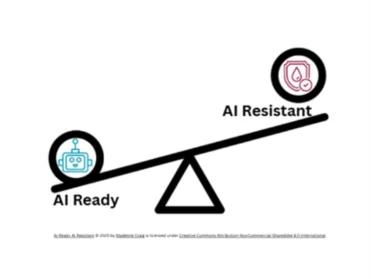
AI's rapid integration into educational environments is reshaping how we teach and learn. From faculty discussions on updated course materials to student interactions with AI tools, the conversation is shifting towards finding harmony between leveraging AI's potential and preserving the essence of authentic learning. The proposed AI Ready and AI Resistant mindset advocates for a balanced approach that encourages educators to embrace AI while safeguarding critical thinking, creativity, and personal voice in the learning process.
Understanding AI Ready vs. AI Resistant
To be AI Ready involves acknowledging and embracing AI's role in education. This means fostering AI literacy among both educators and students, modeling ethical AI usage, and using these tools to enhance creativity and critical thinking. In contrast, an AI Resistant stance focuses on protecting the unique aspects of human learning, such as authentic thought, reflection, and productive struggle. It emphasizes the importance of analysis, interpretation, and synthesis, urging both educators and students to engage thoughtfully with these tools rather than relying on them blindly.
The Risks of Excessive Readiness
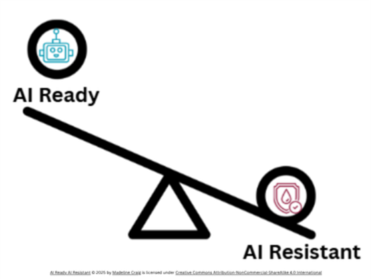
Striking the right balance is essential, as being overly AI Ready can lead to several detrimental outcomes. When we prioritize speed over depth, the learning experience risk becoming mechanical and transactional, devoid of the emotional engagement that enriches education. Overreliance on AI tools may stifle curiosity and diminish critical thinking skills, resulting in a homogenized approach to learning. Caution must be exercised when incorporating the latest AI tools, as the ethical implications, including the potential loss of individual voice and nuanced thought, warrant serious consideration.
The Dangers of Over-Resistance
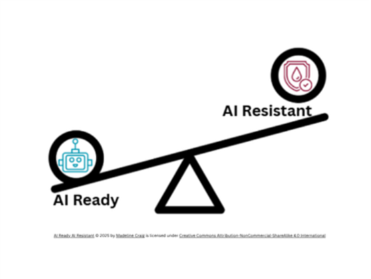
Conversely, an excessive focus on being AI Resistant presents its own challenges. By outright banning AI tools from classrooms, educators risk forgoing opportunities for students to learn responsible AI use and make connections to real-world applications. Moreover, reliance on AI detection tools can alienate students, particularly those whose linguistic backgrounds may bias such systems. Evidence suggests that integrating AI tools can enhance student engagement and academic performance, underlining the necessity of equipping learners for the future where AI will be ubiquitous.
Embracing a Balanced Approach
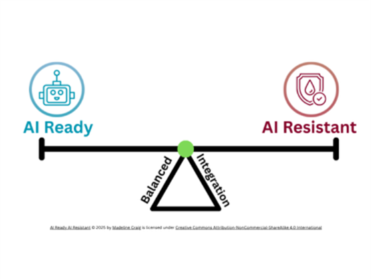
The AI Ready and AI Resistant mindset serves as a practical framework for educators. It advocates for reflective, ethical, and transparent AI integration, promoting human-centered approaches that prioritize the qualities that make us uniquely human while engaging with new technologies. Researchers suggest that just as literacy incorporates reading and writing, AI fluency should also become an essential skill for both personal and professional contexts. Initiatives aimed at increasing AI literacy further emphasize the necessity of preparing educators and students for a future where AI is integral.
Strategizing AI Ready and AI Resistant Teaching
To cultivate both AI Ready and AI Resistant mindsets, educators can implement a range of strategies that balance the use of AI while fostering critical skills. For instance, scaffolded assignments can break larger tasks into manageable steps, allowing for AI-assisted brainstorming while providing ongoing feedback. Project-based learning, which centers around real-world problems, can benefit from AI tools for creativity and solution generation. Similarly, maintaining student portfolios allows for a focus on progress rather than final products, with AI tools utilized to enhance presentations of work.
- Scaffolded Assignments: Breaking larger assignments into chunks with ongoing feedback while allowing for AI use in brainstorming and revision.
- Project Based Learning: Working on collaborative projects with real-world problems, using AI for creative solutions and public presentations.
- Portfolios: Compiling ongoing assessments of student work to showcase growth rather than just final results.
- Gamification: Utilizing ed-tech tools for formative assessments that engage students in learning through AI-integrated platforms.
- Custom AI Chatbots: Developing course-specific bots to facilitate learning and interaction.
Ultimately, the choice to adopt a dual mindset of AI readiness and resistance falls on individual educators. This approach enriches the narrative surrounding AI's role in education, allowing for meaningful engagement with technology while prioritizing the foundations of critical thinking and authentic learning. The dialogue surrounding AI in academia will continue to evolve, and educators must remain active participants in shaping how these tools are integrated into the educational fabric.
Dr. Madeline Craig is an Associate Professor and Technology Integration Coordinator at Molloy University’s School of Education and Human Services. Her work focuses on AI tools for teachers, project-based learning, and online course design. She has published widely, presents nationally, mentors future educators, and blends scholarly rigor with practical innovation.
References
Chaudhary A. A., Arif S., Calimlim R. F., Khan S. Z., Sadia A. (2024). The impact of AI-powered educational tools on student engagement and learning outcomes at higher education level. International Journal of Contemporary Issues in Social Sciences, 3 (2). 2842–2852.
Gotoman, J. E. J., Luna, H. L. T., Sangria, J. C. S., Santiago Jr., C. S., & Barbuco, D. D. (2025). Accuracy and reliability of AI-generated text detection tools: A literature review. American Journal of IR 4.0 and Beyond, 4(1), 1–9. https://doi.org/10.54536/ajirb.v4i1.3795
Kosmyna, N., Hauptmann, E., Yuan, Y. T., Situ, J., Liao, X.-H., Beresnitzky, A. V., Braunstein, I., & Maes, P. (2025). Your brain on ChatGPT: Accumulation of cognitive debt when using an AI assistant for essay writing task [Preprint]. arXiv. https://doi.org/10.48550/arXiv.2506.08872
Ng, D. T. K., Leung, J. K. L., Chu, S. K. W., & Qiao, M. S. (2021). Conceptualizing AI literacy: An exploratory review. Computers and Education Artificial Intelligence, 2, 100041. https://doi.org/10.1016/J.CAEAI.2021.100041
Paschalidis, A.I. (2025, June 24). AI and the great linguistic flattening. UNESCO Ideaslab. https://www.unesco.org/en/articles/ai-and-great-linguistic-flattening
U.S. Department of Labor. (2026, February 13). U.S. Department of Labor releases AI literacy framework providing foundational content areas, delivery principles to guide nationwide efforts. https://www.dol.gov/newsroom/releases/eta/eta20260213

Discussion
Sign in to join the discussion.