This article discusses effective strategies for fostering clinical reasoning in nursing students, emphasizing structured learning over rote memorization.
Many nursing students often request detailed study guides, revealing a deeper need for guidance rather than simply wanting answers for exams. They seek help to navigate the extensive information presented in their courses. Over the years, it has become evident that a traditional approach relying heavily on memorization does not suffice. Success in nursing demands a focus on clinical reasoning, which involves recognizing significant cues, prioritizing patient needs, and articulating rationales behind clinical decisions. This evolution in educational focus is supported by recent research (Gonzalez et al., 2021; Camp-Spivey et al., 2024).
As I interacted with students, I found that their desire for detailed study materials often stemmed from their struggle to identify key information and organize their learning effectively. While some might have been looking for shortcuts, it was clear that most were genuinely seeking reassurance and direction. Rather than providing exhaustive study guides, I shifted towards creating learning activities designed to cultivate the critical thinking skills essential for nursing practice.
The Learning Strategy
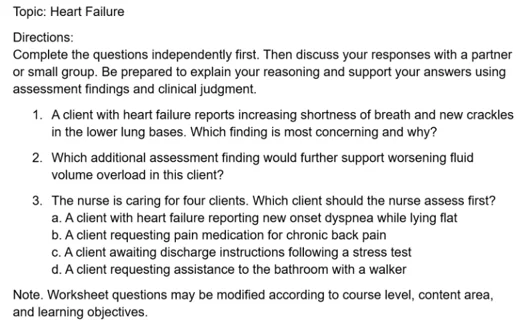
To promote the transition from memorization to clinical reasoning, I began integrating clinical judgment worksheets into my course design. These faculty-developed worksheets present students with brief patient scenarios and involve open-ended questions, prioritization tasks, and application-based inquiries. This format encourages students to identify relevant patient cues and articulate their reasoning, thereby fostering a deeper understanding of clinical judgment (Watkins et al., 2025).
The intention behind these worksheets isn't to eradicate traditional study methods. Instead, they serve as a structured tool for students to engage actively with course material while honing their clinical reasoning skills. For instance, Figure 1 below showcases a sample clinical judgment worksheet that can be modified to align with curriculum objectives. This tool stimulates prioritization, rationale development, and collaborative dialogue among students.
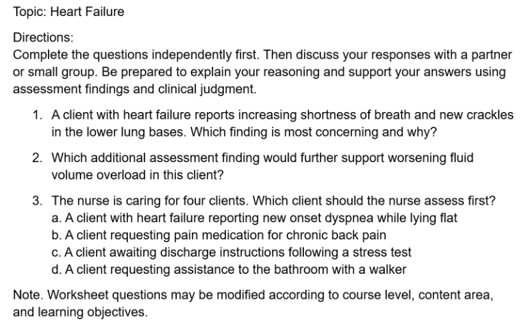
Figure 1. Sample Clinical Judgment Worksheet
Implementation of Worksheets in Class
The approach involves students completing the worksheet independently before engaging in a think-pair-share activity. This format allows them to discuss their responses, rationales, and differing perspectives in pairs before joining a larger group discussion. Such dialogues frequently reveal diverse interpretations of the same case, providing fertile ground for exploring clinical judgment and questioning assumptions.
What’s compelling about this method is the emphasis on reasoning during discussions rather than simply verifying the correctness of answers. Engaging students in dialogue about their thought processes enhances their ability to articulate reasoning, a critical skill in clinical settings. Noted experts Wankier and Beynon (2025) emphasize that environments fostering knowledge application significantly contribute to clinical judgment development.
Surprisingly, the rich classroom conversations often eclipse the worksheets in value, as students gain insight not only from faculty feedback but also from the diverse reasoning their peers display. This peer-to-peer interaction is invaluable in sharpening their clinical judgment skills.
Why This Approach is Effective
This method successfully redirects student focus from rote memorization to the purposeful application of knowledge. A pivotal change occurs in their questions: instead of asking “What’s on the test?” they start to inquire “What’s going on with this patient?” and “What evidence supports my conclusion?”
The strategy also facilitates confidence building. In observing discussions, it’s evident that, while some students may know the right answers, they struggle to express the underlying reasoning. Others refrain from participating due to uncertainty about their rationale. Continuous engagement in structured reasoning tasks helps students articulate their clinical reasoning, justification of decisions, and connection of findings to nursing actions. This is crucial for fostering both confidence and competence.
It’s imperative to clarify that confidence in this context isn't overconfidence but rather reflects a willingness to engage in discussions, share ideas, ask pertinent questions, and explain clinical reasoning processes. Students who can effectively outline the rationale for their judgments and interventions exhibit tangible growth in both knowledge and clinical judgment.
Adapting This Educational Framework
For faculty interested in promoting this learning strategy, starting with manageable scenarios is advisable. Choose a patient case that aligns with the course objectives, and create questions that challenge students to:
- Identify key assessment findings or patient cues.
- Prioritize patient needs and concerns.
- Explain the justification for their decisions.
- Anticipate possible complications.
- Recommend suitable nursing interventions.
The worksheet format needn't be overly complex; often, straightforward scenarios yield the most meaningful discussions. Once students complete their worksheets individually, you can facilitate structured discussions using a think-pair-share model. During these discussions, encourage respectful challenges to assumptions and consideration of alternate perspectives.
This educational model can be tailored to fit various nursing courses, learner levels, and educational objectives. The ultimate goal isn't simply to prepare students for exams but to offer them experiences that require critical thinking in real-world clinical situations while articulating their reasoning processes.
Final Reflections
A significant takeaway from this educational shift is recognizing that students often misidentify their needs. Requests for more precise study guides typically reflect a longing for true understanding and guidance in navigating complex clinical information.
Nursing educators carry the responsibility of not only preparing students for exams but also equipping them to think critically about patient care. Strategies that promote analysis, reasoning, and engaging discussions enable students to develop competencies that extend beyond memorization. Active learning approaches, which progressively shift focus from recall to application, are corroborated by ongoing research as essential in clinical education (Watkins, Fruin, and Brett, 2025).
The mission isn't about precisely outlining exam content but is fundamentally about cultivating the thought processes necessary for effective patient care.
Dr. Rosa Diaz-Herring, DNP, RN, CNE, serves as an Assistant Professor of Nursing at Southern Connecticut State University. Her educational journey spans various nursing programs, focusing on enhancing clinical judgment and confidence among students through active learning strategies.
References
Camp-Spivey, L. J., Crawford, R. P., and V. Bratnichenko. 2024. “Bringing Next Generation NCLEX-RN Case Studies to Life Through Simulation: Enhancing Prelicensure Nursing Students’ Clinical Judgment.” Clinical Simulation in Nursing 91: Article 101535.
Gonzalez, L., A. Nielsen, and K. Lasater. 2021. “Developing Students’ Clinical Reasoning Skills: A Faculty Guide.” Journal of Nursing Education 60 (9): 485–493.
Wankier, J., and C. Beynon. 2025. “Enhancing Clinical Judgment in Undergraduate Clinical Education.” Teaching and Learning in Nursing 20 (1): 32–36.
Watkins, M., B. W. Fruin, and A. Brett. 2025. “Using Active Learning to Develop Clinical Judgment in Nursing Students.” Teaching and Learning in Nursing 20 (4): e1170–e1175.

Discussion
Sign in to join the discussion.