PISA data reveals mixed outcomes in student performance linked to AI usage, prompting critical evaluations of technology's role in education.
The Rise of AI in Education
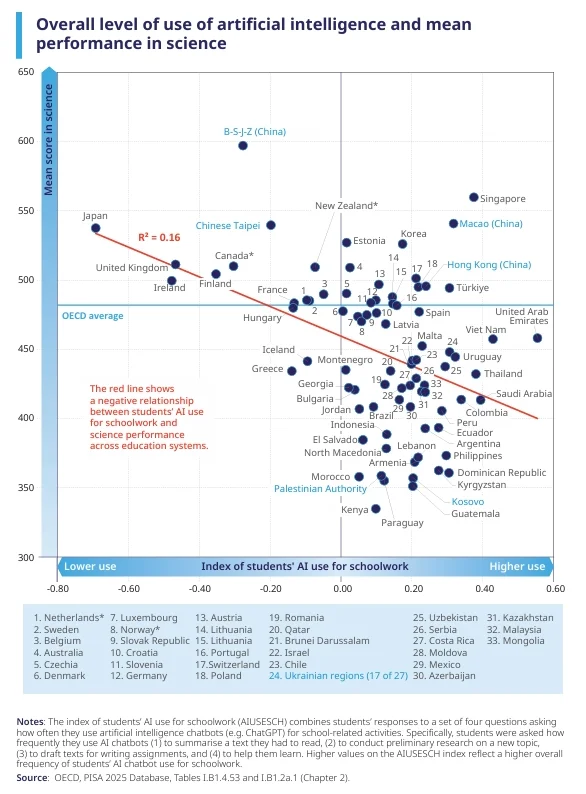
Generative artificial intelligence has quickly infiltrated classrooms worldwide, reshaping how students approach their work. Recent data from the Programme for International Student Assessment (PISA) indicates that over 40% of students across several countries are now using AI chatbots for tasks like drafting essays and completing assignments. In certain regions like Viet Nam, the usage rate spikes to 52%, revealing a significant trend in AI adoption among learners.
Teacher Observations and Concerns
Many educators are not surprised by these findings. A growing number are employing AI to assist in lesson planning and grading, and they’ve noted a shift in student submissions, which often appear more refined and timely. This reliance on AI raises pressing questions about originality and the true impact of technology on educational outcomes.
AI Usage vs. Academic Performance
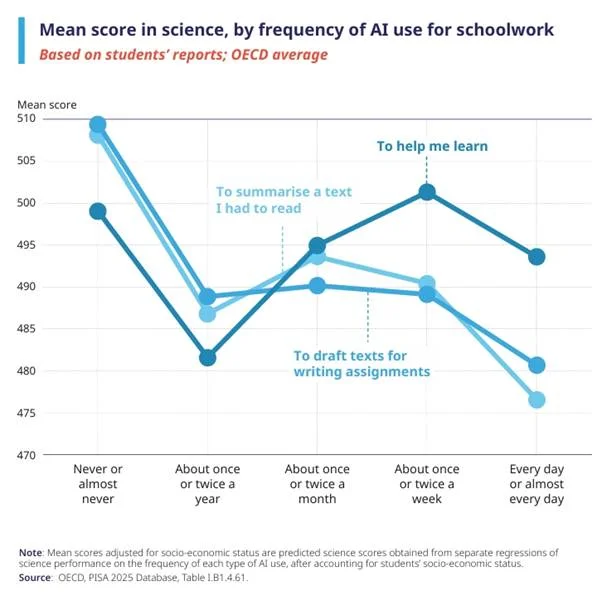
The crux of the debate lies in whether this technology genuinely aids learning. Surprisingly, PISA’s findings paint a concerning picture. Students who regularly employ AI chatbots typically score lower in science assessments compared to their peers who do not. On average, those relying on AI for summarizing texts or drafting assignments lag behind by about 20 points, equating to nearly a year of education. In some countries, like Canada and New Zealand, the performance gap widens even further—by 29 and 36 points, respectively.
While these statistics are sobering, they don't establish a straightforward causal link. Lower scores could stem from various factors, such as students who struggle academically leaning more on AI tools for assistance.
Complex Relationships and Outcomes
The dynamics between AI usage and science performance can also be more nuanced. In Thailand and Macao, for instance, students who use AI to draft assignments daily outperform their peers by 24 and 21 points, respectively. It appears that frequency and intention behind AI usage make a significant difference. Students who engage with AI for learning once or twice a week tend to perform comparably to non-users, highlighting that moderation can be key to effective learning.
Interestingly, those who learn how to evaluate AI-generated information may experience slightly improved science outcomes. However, access to these beneficial experiences often varies, raising concerns about an emerging divide based on student advantages.
Comparative Insights from Global Systems
When we look at high-performing educational systems, contrasts in AI utilization show varying results. Countries like Korea and Singapore, which have effectively integrated comprehensive policies for digital learning and AI usage, boast strong science scores. Conversely, in Japan and Estonia, where AI adoption is more limited, students still excel in assessments.
Evaluating AI's Educational Impact
The mixed bag of findings leaves room for reflection. Proponents advocate for AI's potential in personalization and immediate feedback, which could theoretically enhance student performance. Yet, current evidence lacks clarity in supporting these claims.
The OECD’s Digital Education Outlook suggests that while educational AI tools can promote sustained learning, general-purpose AI often leads to superficial engagement and cognitive offloading, fostering what researchers term “metacognitive laziness.” The implications of this use are concerning.
The Need for Caution in Education Technology
In contrast to rigorous pre-implementation testing in healthcare, educational technologies, including AI, are often deployed without sufficient evaluation of their effectiveness. This lack of scrutiny may explain some of the pitfalls experienced with AI in education, as it can sometimes exacerbate existing issues rather than alleviate them.
Guidelines for Responsible AI Usage
Looking ahead, it’s clear that educational authorities need to craft explicit guidelines for AI usage in schools. Topics such as pedagogical value, age appropriateness, academic integrity, and data privacy should be at the forefront of these discussions. Initiatives like the OECD-EU AI Literacy Framework serve as pivotal resources for effective AI integration.
Moreover, educators require comprehensive training on the strengths and constraints of AI tools to avoid either over-dependence or outright dismissal of potentially beneficial applications.
Final Thoughts
The key takeaway is the importance of critical engagement with generative AI. While it can enhance the educational experience under the right conditions, misapplication risks diluting the very skills educational frameworks aim to cultivate. As it stands, the data urges a cautious approach; until clearer evidence emerges around AI's positive educational impact, both educators and students should exercise prudence in its use.
This analysis draws from insights found in the PISA 2025 Insights and Interpretations brochure.
Note: An asterisk (*) next to a country's name indicates caution is advised when interpreting these findings due to unmet PISA sampling standards (reference the Reader’s Guide in the PISA 2025 Results Volume I).

Discussion
Sign in to join the discussion.