Assessments should reflect true intelligence by valuing collaboration and interaction over individual knowledge, enhancing collective learning outcomes.
**Redefining Assessment: The Case for Collective Learning**
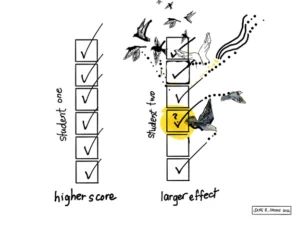
Think about two students tackling the same project. One is a textbook star, armed with knowledge and quick to complete her tasks. She excels in the traditional sense, scoring high marks because she memorizes every detail. The other student, while not as factually dense, brings a different set of skills to the table. His understanding is still developing, yet he knows how to engage the group. He asks the pivotal questions that steer the discussion, spots the quieter voices that need encouragement, and breaks down complex ideas into digestible concepts. When a peer feels overwhelmed, he's there to help her reframe her approach.
In the end, the first student garners a better grade—a predictable outcome in an education system that rewards individual knowledge over collaborative skills. But should the scoring equate to true intelligence? This dichotomy reveals a significant flaw in our assessment systems.
**A Flawed Metric of Intelligence**
Current evaluation methods hinge on a narrow definition of intelligence, positing that knowledge, skills, and even emotional intelligence reside solely within each student. This mindset drives assessment practices that isolate learners. By creating environments designed to test individual knowledge under stress—quiet rooms, timed tests—we claim to be measuring authentic learning. Yet, such setups fail to capture the essence of critical thinking and problem-solving that happen during collaboration.
Carnegie Mellon researchers, including Anita Woolley and Thomas Malone, uncovered the concept of *collective intelligence*, showing that a group's success doesn’t depend solely on the smartest individuals. Performance is intertwined with how group members work together. It's not just what each person brings individually; it’s also the interactions among them that produce more significant results.
Annie Murphy Paul makes a further philosophical leap in her book *The Extended Mind*, arguing that thinking extends beyond the confines of the individual brain. Our knowledge and understanding evolve through our physical environment, the tools available to us, and the relationships we cultivate. Interactions with peers not only support our thinking—they actually shape it. You probably recognize this: while articulating a complicated idea, you might find clarity mid-sentence. A colleague's question could shine a light on an unexplored angle, or a student’s confusion may reveal weaknesses in your explanation.
In essence, the most profound learning occurs in these exchanges, yet traditional assessments fail to account for them.
**The Dichotomy of School Values**
Schools profess a commitment to collaboration, communication, and empathy, yet they simultaneously enforce practices that foster isolation. When evaluating knowledge, we push desks apart and command students to focus solely on their own work. This contradictory behavior demonstrates a measurement problem: tracking individual knowledge is straightforward and allows for quantifiable grades. In contrast, the impact one student has on another is often invisible, making it difficult to gauge its significance.
We should be asking critical questions about what occurs during group learning. Did one student elevate the quality of questions? Did another help a classmate overcome difficulty? Such contributions might not be reflected in traditional scores, yet they are vital to understanding the full spectrum of learning.
The reluctance to measure these collective dynamics sends a clear message to students: collaborative skills are secondary. When assessments prioritize recall over interaction, they inadvertently diminish the importance of skills like questioning and synthesis. Recognizing and valuing these contributions is fundamental; it could reshape how learning occurs.
Imagine a world where we acknowledge and assess collaboration and engagement as essential to education. Such a shift could redefine what it means to be educated in the twenty-first century.The current discourse around educational assessment is shifting, moving away from conventional metrics like grades and test scores toward a more holistic approach that emphasizes collaboration and community impact. This transition is vital in understanding how students not only learn but also contribute to the learning of others. The concept of “Ripples of Impact” serves as a framework to measure these contributions. It encourages educators to seek not just straightforward results but a deeper inquiry into the dynamics of learning.
### Redefining Educational Impact
Traditional methods often simplify achievement into quantifiable data, focusing strictly on what students know or can do. This overlooks the significant influence a student may have on their peers, the conversations sparked, or the collaborative discoveries made in a classroom. The real value of education lies in these interpersonal exchanges, where learning flows from one mind to another, creating a network of insights that often transcends the classroom environment altogether.
Consider this: What if, instead of asking, "Did the student grasp the material?" we also asked, "Who benefited from this student's understanding?" This simple shift positions students as active participants in a larger learning ecosystem rather than mere recipients of information. It sparks curiosity about the broader implications of their learning journeys, something traditional assessments are ill-equipped to capture.
### Embracing Participation
The role of students in these assessments goes beyond data collection. They should be integral to the evaluation process, actively identifying their growth and reflecting on how they impacted others. This collaboration fosters a sense of agency and responsibility, contrasting sharply with a system that often views students as passive subjects.
This constructive dialogue can take various forms, from project reflections to peer feedback sessions. Educators can turn these insights into actionable strategies, ensuring learning is not static but a continuous evolution. For example, if a student aids a classmate in grasping a difficult concept, that moment should be recognized and built upon, perhaps signaling a need for more collaborative opportunities in lessons.
### Looking Ahead: A Paradigm Shift in Assessment
So, what's the takeaway? If you're involved in education, now’s the time to reconsider assessment paradigms. Rather than merely documenting where students are, it’s crucial to envisage the possibilities for tomorrow’s learning environments. The emphasis should be on making the learning process visible, tracking how students form connections, solve problems collaboratively, and bring their insights into varied settings.
Ultimately, education’s purpose is not simply to create knowledgeable individuals but to nurture a community where learning catalyzes more learning. The benefits extend far beyond academic outcomes, helping to cultivate a culture of mutual support and collective intelligence that will serve students well into their futures. By embracing these new assessment methodologies, schools can foster environments where every student's presence enhances the learning experience for all—making every interaction a potential ripple of impact.
Discussion
Sign in to join the discussion.