Transform nursing education by shifting focus from memorization to clinical reasoning, fostering deeper understanding and confidence in students.
Many nursing students often express a desire for more structured study guides, but the request frequently reveals a deeper need for guidance through an overwhelming amount of course material. It’s less about knowing exactly what will appear on exams and more about seeking reassurance and direction in their academic journey.
Students enter nursing programs with a reliance on memorization, but true success in this field requires the ability to analyze clinical scenarios, prioritize patient needs effectively, and apply knowledge in novel contexts. Emphasizing the development of clinical reasoning and judgment is increasingly central to nursing education (Gonzalez et al., 2021; Camp-Spivey et al., 2024).
Upon reflection, I’ve noticed that students seeking detailed study guides are often struggling to pinpoint the essential elements of their learning. Some candidly request, “Can you just tell us exactly what to study?” While a minority may hope for an easy way out, many actually need structured guidance. Rather than providing repetitive detailed study guides, I've shifted to creating engaging learning experiences that facilitate practice in critical thinking and clinical decision-making.
The Strategy
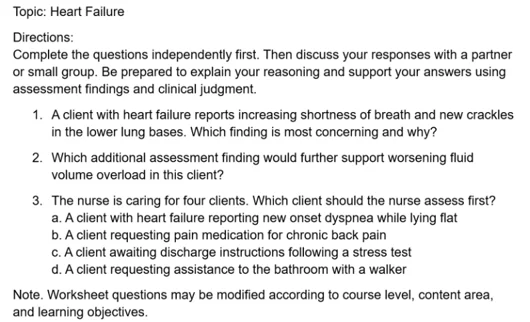
To bridge the gap between rote learning and clinical reasoning, I have integrated recognition-based clinical judgment worksheets into my teaching framework. These worksheets incorporate brief patient scenarios along with open-ended inquiries and prioritization tasks. They require students to engage with the material on a deeper level, focusing on identifying significant patient cues, explaining their thought processes, prioritizing issues, and justifying nursing decisions.
These tools aren’t meant to replace traditional studying methods like reading and attending lectures; rather, they complement these methods by providing a structured way to engage interactively with coursework while honing clinical reasoning skills. An example of this worksheet can be seen in Figure 1, showcasing its adaptability to different learning objectives and course content. By emphasizing cue recognition, prioritization, and collaborative discussions, these worksheets promote active engagement with critical clinical concepts.
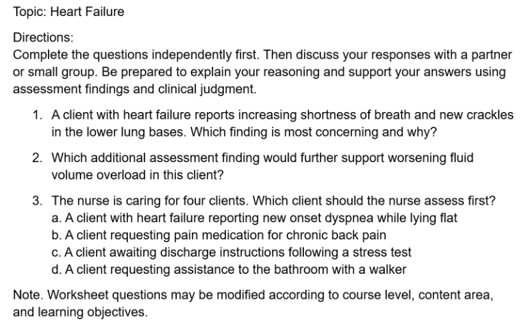
Figure 1. Sample Recognition-Based Clinical Judgment Worksheet
Implementation in the Classroom
The implementation begins with students completing the worksheets independently. Following this, I employ a think-pair-share format, encouraging them to compare their answers, discuss their rationales, and consider differing perspectives before engaging in a larger class dialogue.
These discussions often unveil diverse approaches to the same patient scenario, which can be incredibly enriching. This environment fosters critical dialogue about clinical judgment, prompting students to challenge assumptions and explore multiple valid approaches to patient care.
Faculty-led discussions during this process focus less on right or wrong answers and more on the reasoning behind decisions. This method promotes the habit of articulating thought processes rather than merely landing on a definitive answer. As Wankier and Beynon (2025) emphasize, opportunities for students to exercise their knowledge and engage in deep clinical reasoning are fundamental to developing effective clinical judgment.
Interestingly, one unexpected outcome has been the enhanced quality of discussions. Students often present varied conclusions about the same situation, allowing for rich discussion about rationale and alternative strategies, ultimately providing a deeper understanding of the material than the worksheets alone could offer.
Why the Strategy Is Effective
This approach shifts students' mindset from focusing on test content to genuinely considering patient situations. Instead of wondering, “What’s on the test?” they begin to inquire, “What’s happening with this patient? How do I know?”
Moreover, this method bolsters their confidence. Throughout discussions, I've observed students confidently arriving at the correct answers yet struggling to articulate their reasoning. Conversely, some hesitate to share their thoughts due to uncertainty about their conclusions.
As students repeatedly engage in structured activities, they learn to clearly express clinical thought processes, defend their decisions, and correlate assessment findings with nursing actions. This iterative practice nurtures both confidence and clinical competence.
It’s essential to clarify that confidence here doesn’t equate to overconfidence. Instead, it signifies a learner's readiness to engage, share ideas, ask questions, and articulate clinical reasoning. Students adept at explaining their rationale for decisions and prioritizing patient issues reflect significant growth in both knowledge and clinical judgment.
Adaptation for Faculty
Nursing faculty eager to implement this method can start with manageable steps. Select case scenarios aligned with course objectives and develop questions that prompt students to:
- Identify key assessment findings or patient cues
- Prioritize patient concerns
- Articulate the rationales for their decisions
- Anticipate potential complications
- Recommend suitable nursing interventions
The worksheets need not be extensive or complex. In fact, uncomplicated scenarios often yield the most productive discussions as they require students to clarify their thinking process.
After students complete their worksheets, employing a structured discussion strategy like think-pair-share can be effective. This allows them to compare rationales and challenge assumptions constructively while engaging with different perspectives. Faculty can guide this conversation towards the reasoning processes that underpin safe and effective patient care.
The specific format can be tailored to fit various nursing courses, learner levels, and educational objectives. The ultimate goal transcends merely providing a narrowed list of study materials; it's about cultivating an environment where students can practice navigating real clinical scenarios while verbalizing their thought processes.
Final Thoughts
A key lesson from this experience is recognizing that student requests for detailed study materials may not reflect their true needs. Instead of asking for answers and shortcuts, they often seek support in how to learn, organize their information, and navigate complex clinical scenarios.
Nursing educators have a responsibility to cultivate critical thinking and reasoning capabilities that prepare students for real-world patient care. Educational strategies that focus on analysis, explanation of reasoning, and meaningful, engaging discussions can significantly help facilitate this transition. Ongoing research continues to advocate for active learning methodologies that propel students from memorization towards applying knowledge within clinical contexts (Watkins, Fruin, and Brett, 2025).
Ultimately, the focus should not be on dictating what will be included on a test but rather on equipping students with the thinking habits necessary for effective patient care.
Dr. Rosa Diaz-Herring, DNP, RN, CNE, serves as an Assistant Professor of Nursing at Southern Connecticut State University. With a wealth of experience teaching various nursing programs, her efforts center on enhancing clinical judgment, confidence, and active learning strategies for safe practice.
References
Camp-Spivey, L. J., Crawford, R. P., and V. Bratnichenko. 2024. “Bringing Next Generation NCLEX-RN Case Studies to Life Through Simulation: Enhancing Prelicensure Nursing Students’ Clinical Judgment.” Clinical Simulation in Nursing 91: Article 101535.
Gonzalez, L., A. Nielsen, and K. Lasater. 2021. “Developing Students’ Clinical Reasoning Skills: A Faculty Guide.” Journal of Nursing Education 60 (9): 485–493.
Wankier, J., and C. Beynon. 2025. “Enhancing Clinical Judgment in Undergraduate Clinical Education.” Teaching and Learning in Nursing 20 (1): 32–36.
Watkins, M., B. W. Fruin, and A. Brett. 2025. “Using Active Learning to Develop Clinical Judgment in Nursing Students.” Teaching and Learning in Nursing 20 (4): e1170–e1175.

Discussion
Sign in to join the discussion.