Embracing Indigenous Wisdom: A Community-Focused Teaching Framework for Higher Education
RELEASE Oct 16, 2026VIEWS 602DESK Carol Ducharme and Safieh Moghaddam, PhD
Discover the Relationship Before Research Framework, promoting inclusive and responsive teaching that honors Indigenous community wisdom in academia.
A New Approach to Community-Centered Teaching in Higher Education
In academia, the integration of Indigenous perspectives into curricula is a noble goal, yet it often faces significant hurdles. Many educators genuinely want to infuse their teachings with experiential learning and community engagement, yet they struggle to find effective entry points. Importantly, the focus often centers on whether this inclusion is necessary—yet, the real challenge lies in figuring out how to execute it properly.
If community voices aren’t involved continuously, attempts to introduce Indigenous content can risk being mere tokens rather than authentic incorporations. Moreover, institutional pressures can force educators to rush into course outcomes before the essential groundwork of trust and relationships is laid. This recognition comes from real-world experiences, specifically those of Safieh Moghaddam, a non-Indigenous educator at the University of Toronto Scarborough, who in collaboration with Indigenous colleagues like Carol Ducharme, and local Elders from Curve Lake First Nation, unearthed vital insights into the challenges and possibilities of engaging with community wisdom.
Moghaddam soon understood that approaching this transformative work required humility and patience. The mindset of an expert needed to be replaced with that of a learner, allowing community relationships to steer the educational process. This shift isn’t just a matter of optics; it takes courage. It requires stepping back and resisting the urge to dictate the course, instead letting the community define the direction of learning.
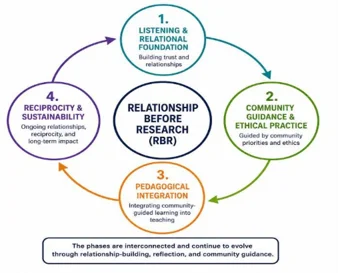
What has emerged from this partnership is the Relationship Before Research (RBR) Framework, a guiding approach cultivated from deep collaboration with Indigenous communities. This framework pivots on community leadership, mutual respect, and relational accountability rather than predetermined syllabi or rigid plans. What’s particularly noteworthy about the RBR Framework is that it isn’t a one-size-fits-all solution; rather, it invites a more thoughtful and nuanced approach to community-engaged education.
The article elaborates on four critical phases within this framework: laying a relational foundation through listening, integrating ethical practices via community guidance, merging pedagogical techniques, and ensuring sustainability and reciprocity in educational engagements. These elements underscore that strong community-educator collaborations should be dynamic, evolving as they respond to ongoing community input rather than adhering strictly to academic schedules.
At its core, this paradigm of teaching emphasizes a profound shift from traditional instructor-led platforms to a more inclusive and responsive model that honors Indigenous wisdom and fosters long-term partnerships. As educators, grappling with institutional confines demands innovative approaches—this framework could be a significant step toward more meaningful and responsible teaching methods in higher education.
The Need for Continuous Reflection in Educational Practices
As we wrap up this discussion, it's clear that the journey toward decolonizing education is far from complete. The works referenced here highlight a growing body of knowledge that calls for intentional reflection on how we teach and learn. The insights from Battiste and Kirkness, coupled with the foundational principles established in OCAP protocols, challenge educators to rethink their approaches and actively engage with Indigenous perspectives.
When you glance at the titles and authors—from Smith's critical examination of methodologies to Wilson's advocacy for Indigenous methods of inquiry—you see an urgent call to action. This isn't merely about adding Indigenous content to existing curricula; it's about reshaping the educational framework entirely. Tuck and Yang remind us that decolonization transcends mere metaphor; it requires concrete actions that address historical injustices.
If you're in the education space, consider the implications of the Truth and Reconciliation Commission’s calls to action. These aren't just recommendations; they should be viewed as essential steps toward building a more inclusive and equitable educational landscape. The push for respectful engagement, as advocated by Kirkness and Barnhardt, isn't optional—it's a necessary commitment that can redefine not just curricula but also relationships between educators and communities.
So, what does this all mean moving forward? The responsibility to transform these insights into practice lies with each of us. Questions about how we can responsibly incorporate these perspectives into our classrooms remain, and there's much work to be done. It’s imperative that we maintain a dialogue about these resources, questioning the effectiveness of our methodologies and the depth of our engagement with Indigenous communities.
For those of us committed to educational reform, now is the time to act—reflect, adapt, and collaborate. The future of education depends on it.
Source:Carol Ducharme and Safieh Moghaddam, PhD · s39613.pcdn.co
Discussion
Sign in to join the discussion.